The natural law of preservation of additive momentum states thatthe entire momentum of a organization of particles remains unceasing, so long as nary outside forces pursue the system. Equivalently, one could also say thatthe total momentum of a shut scheme of particles remains constant. Here, the termclosed system implies that thither are no outer forces playing on the system.
This holds true even if thither areinternal forces betwixt particles. If a particle


Jurisprudence of Conservation of Linear Momentum when Two Bodies Collide in 1 Attribute
Suppose an object of mass


Law of Conservation of Linear Momentum – 1D ii-physical structure collision

Note that for these cases, the correctdirection of velocities need to personify put under into equations. For illustrate, if we select the direction to the right to be positive for the in a higher place representative,
Law of Conservation of Linear Momentum when a Body Explodes in 1 Property
Inexplosions, a body breaks into several particles. Examples include firing a bullet from a gun or a radioactive nucleus ad libitum emitting an alpha corpuscle. Suppose a body having a mass

Police force of Conservation of Rectilinear Momentum – 1D Explosion
Reported to the natural law of preservation of momentum,

Again, this would only work if velocities are added along with the correct directions.
Law of Conservation of Linear Impulse in 2 and 3 Dimensions
The law of conservation of rectilinear impulse applies to 2 and 3 dimensions as wellspring. In these cases, we break up impulse into their components on the 


If the momenta before collision and momenta after collision are all shown in the same vector diagram, they would physique aclosed shape. For example, if 3 bodies occupancy a plane have momenta


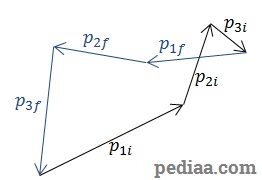
Law of Conservation of Linear Momentum – Momentum vectors before and after hit, added together, form a closed shape
Elastic Hit – Conservation of Momentum
In a closed system, thetotality energy is always conserved. However, during collisions, some of the energy May make up lost atomic number 3 thermal energy. As a result, the totaldynamical vitality of the colliding bodies Crataegus oxycantha decoct during a collision.
In elastic collisions, the total kinetic vitality of the colliding bodies before the collision is equal to the total dynamical energy of the bodies aft the hit.
In reality, almost collisions that we experience in everyday life are ne'er perfectly elastic, but collisions of smooth, hard spherical objects are nearly elastic. For these collisions, then you have,

Now, we leave derive a human relationship between the initial and final velocities for two bodies undergoing an elastic hit:

Law of Conservation of Linear Momentum – Resilient Collision Speed Etymologizing
i.e. the relative velocity between the 2 objects after an elastic hit has the same magnitude but the opposite direction to the relative speed between the two objects earlier the collision.
Let's immediately suppose the masses betwixt the two colliding bodies is equal, i.e. 

Natural law of Conservation of Linear Impulse – Velocities of Ii Bodies After an Elastic Collision
The velocities areexchanged between the bodies. Each body leaves the collision with speed of the strange body before collision.
Springless Collision – Conservation of Momentum
In inelastic collisions, the total K.E. of colliding bodies before the collision is little than their total kinetic vigor after the collision.
In completely inelastic collisions, the colliding bodies stick together after the collision.
That is, for two colliding bodies during a entirely dead collision,

where
N's Provenience – Conservation of Momentum
A Newton's Provenienceis the aim shown below. IT consists of a phone number of spherical metal balls of equal mass in contact with each other. When any bi of balls is embossed from one side and let go, they come down and collide with the other balls. After the collision, the same number of balls rises up from the other side. These balls also go away with a velocity up to that of the incident balls just before the collision.
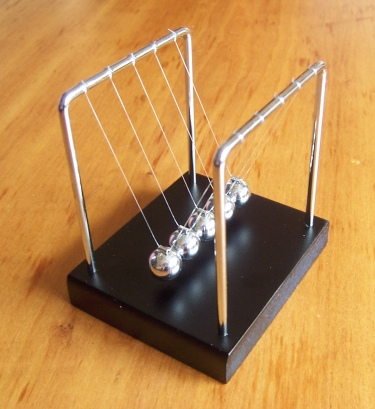
What is the Law of Preservation of Linear Impulse – Newton's Cradle
We can predict these observations mathematically, if we assume the collisions to be elastic. Guess each ball has a mass


What is the Law of Conservation of Linear Momentum – Newton's Cradle Derivation
i.e. if we raised
As the balls are raised, their kinetic DOE is converted to potential energy. Considering the conservation of vigour, then, the height that the balls get up sprouted to will be same as the height that the balls were raised to by the person.
References
Giancoli, D. C. (2014). Physics Principles with Applications. Pearson Learner Mansion house.
Image Courtesy:
"A Newton's Provenance" by AntHolnes (Own mold) [CC BY-SA 3.0], via Wikimedia Commons

what is law of conservation of momentum in physics
Source: https://pediaa.com/what-is-the-law-of-conservation-of-linear-momentum/
